
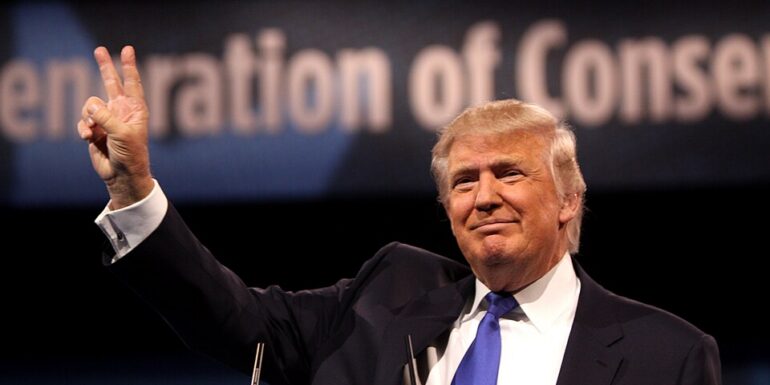

Trump’s endorsement appears to carry real weight again inside Republican primaries after Indiana Republicans delivered major wins to candidates backed by the former president.
Back in December, several Indiana state senators who opposed Republican-backed redistricting efforts drew primary challengers with Trump’s support. Trump-backed challengers won at least five races outright, while another contest remained too close to call, creating what many Republicans now view as a warning shot against opposing the former president on major party priorities.
The victories immediately fueled momentum for redistricting fights in conservative states such as South Carolina, Alabama, Tennessee, Louisiana, and Florida, where Republicans continue debating congressional maps ahead of the next election cycle. Indiana Republicans largely viewed the primaries as political fallout from the state Senate rejecting Trump’s mid-decade redistricting push. Republican lawmakers across the South also accelerated new map discussions following recent Supreme Court rulings on race-based districting.
Democrats and voting-rights activists continue framing those efforts as attempts to weaken African American voting power. Republicans counter that argument by pointing toward recent Supreme Court rulings that restrict race-based districting. The Court reinforced that position in Alexander v. South Carolina State Conference of the NAACP, where the justices ruled courts cannot automatically treat partisan redistricting as unconstitutional racial gerrymandering simply because race and voting patterns overlap.

In Louisiana v. Callais, decided earlier this year, the Supreme Court ruled that Louisiana relied too heavily on race when drawing a second majority-Black congressional district. The Court argued that “the Constitution almost never permits a State to discriminate on the basis of race” and rejected the idea that federal voting law automatically justified race-focused redistricting.
Republicans now point toward that ruling as legal backing for broader redistricting efforts across the South. These races in Indiana show that Republican voters still respond when Trump draws a line in the sand, especially on issues tied to party control and legislative power.